7 Signs Your School's HVAC Failure Is a True Emergency
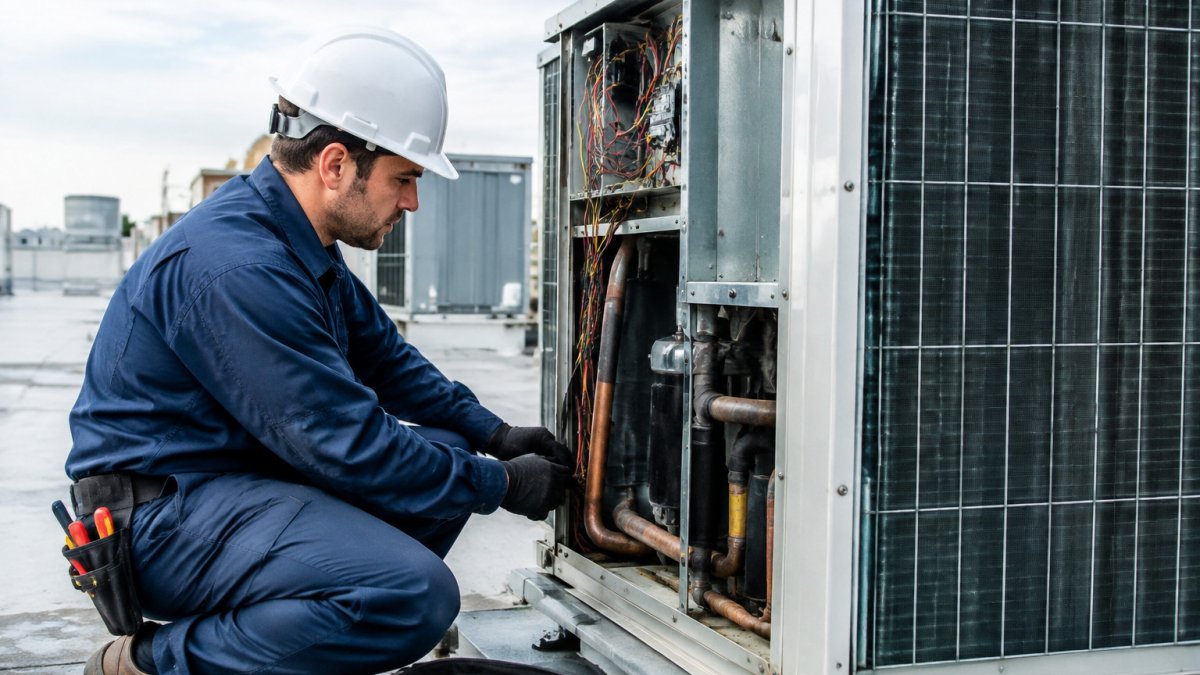
Last Updated: November 7, 2026
Quick Summary
An emergency HVAC repair for a school is any equipment failure that puts occupants at risk or makes the building unsafe or unusable, such as a carbon monoxide alarm, burning odor, gas odor, or loss of heat in freezing weather. Life-safety hazards call for immediate action and closure before any diagnosis.
- A carbon monoxide alarm is a life-safety event, so evacuate and call emergency services before the HVAC contractor.
- Smoke, burning odors, or gas odors near heating equipment require closing the affected area immediately.
- Set written comfort thresholds in advance, using roughly 80°F for cooling and 68°F for heating during occupied hours.
- Prepare building address, equipment make and model, and failure details before calling to speed same-day response.
- Never use space heaters or defeat fire dampers as workarounds, since both create serious fire and safety risks.
Table of Contents
- What Is Considered an HVAC Emergency in a School Building?
- Deciding When to Close Part or All of a School Because of HVAC Failure
- Building a School HVAC Emergency Response Plan
- Getting Same-Day HVAC Repair Without Waiting Weeks
- Setting Up an HVAC Service Agreement for Your Schools
- Frequently Asked Questions
Emergency HVAC repair for schools is one of the calls that matters most for facilities teams across Northeast Ohio. When heat fails in January or cooling drops in September, a classroom can become unusable within hours. Facilities managers need to know quickly whether a failure is an emergency or a problem that can wait for scheduled service.
What Is Considered an HVAC Emergency in a School Building?
An HVAC emergency in a school is any equipment failure that puts occupants at risk or makes the building unsafe or unusable.
Schools differ from most commercial buildings. Children are more vulnerable to temperature extremes and poor air quality, and classrooms are occupied on a fixed schedule. A failure at 6 a.m. may be manageable; the same failure at 10 a.m. with a full gymnasium is not.
Conditions That Require Immediate Action
Some conditions should trigger an emergency call right away, without waiting for a diagnosis:
- Carbon monoxide alarm activation. Stop occupancy in affected areas, evacuate, and call emergency services before the HVAC contractor.
- Burning smell or visible smoke from air handlers, furnaces, or boilers.
- Gas odor near heating equipment.
A common mistake is treating a carbon monoxide alarm as a maintenance ticket. It is a life-safety event first.
Problems That Can Wait for Scheduled Service
Not every failure needs same-day dispatch. A noisy blower motor with normal airflow, a filter that needs replacement, a thermostat drifting a degree or two, or a single room running slightly warm can usually be scheduled. Documenting these items and grouping them into planned preventive maintenance often costs less than emergency calls and reduces the chance of a larger failure later.
Deciding When to Close Part or All of a School Because of HVAC Failure
The closure decision belongs to school leadership, but the HVAC contractor's diagnosis should inform it. The most useful framework separates life-safety triggers from comfort and operational triggers, because they call for different responses and timelines.
Life-safety triggers: close immediately
Close the affected area, and in some cases the building, without waiting for a contractor diagnosis when any of the following is present:
- Carbon monoxide alarm activation. Evacuate the affected zone, call 911, and do not reoccupy until the fire department clears the space and the source is found. A CO alarm is never a maintenance ticket.
- Smoke, burning odors, or visible sparks from air handlers, furnaces, boilers, or electrical panels.
- Gas odor near heating equipment or in a mechanical room.
In these cases the closure is not discretionary. Document the time of evacuation, the areas cleared, and the authority who ordered it.
Comfort and operational triggers: partial closure first
When there is no life-safety hazard, the question becomes whether occupied spaces can be held within a defensible comfort range. Set written thresholds in advance rather than debating them during a failure. A common pattern is to treat a classroom as unusable when it cannot be held below roughly 80°F in cooling season or above roughly 68°F in heating season during occupied hours, with tighter limits for spaces serving young children, students with health plans, and students with disabilities.
Apply the decision in this order:
- Identify the affected zones. Use BAS trend logs or zone controller readouts to see which rooms are actually out of range, rather than assuming the whole wing is down.
- Check whether relocation is feasible. Move students to conditioned spaces that can absorb the headcount, media centers, cafeterias, and gyms are common destinations, but confirm capacity and adequate ventilation first.
- Limit room use before closing the building. A single failed rooftop unit serving four classrooms is usually a partial-closure event, not a whole-building event.
- Escalate to full closure when the failure affects the whole building, when no conditioned space can absorb displaced students, or when the contractor's diagnosis indicates the repair will extend past the current school day.
Ventilation and indoor air quality triggers
A building can be thermally comfortable and still be a closure candidate. If outdoor-air dampers are stuck closed, exhaust fans have failed, or filtration is bypassed, carbon dioxide and pollutant levels can climb in densely occupied rooms even with the temperature in range.
Watch out: never direct custodial staff to run a space heater, open a roof hatch, or block a fire damper as a workaround.
Documenting the decision
Keep a written record of the decision, the time it was made, the readings or alarms that supported it, the areas closed, and the person who authorized it. Families, district staff, and the school board will ask, and a clear record protects the people making the call.
The article separates closure triggers into three groups, each calling for a different response.
| Trigger | Response | Timing |
|---|---|---|
| Carbon monoxide alarm | Evacuate affected zone, call 911 | Immediately, no waiting for diagnosis |
| Smoke or burning odor from equipment | Close affected area | Immediately |
| Gas odor near heating equipment | Close affected area | Immediately |
| Water intrusion near electrical panels | Close affected area | Immediately |
| Classroom above ~80°F cooling or below ~68°F heating | Partial closure of affected rooms | Occupied hours; thresholds set in advance |
| Whole-building failure or no conditioned space for students | Full building closure | When relocation is not feasible |
Building a School HVAC Emergency Response Plan
A school HVAC emergency response plan works best when it is written before a failure happens. Assign one person as the primary contact for HVAC emergencies and a backup.
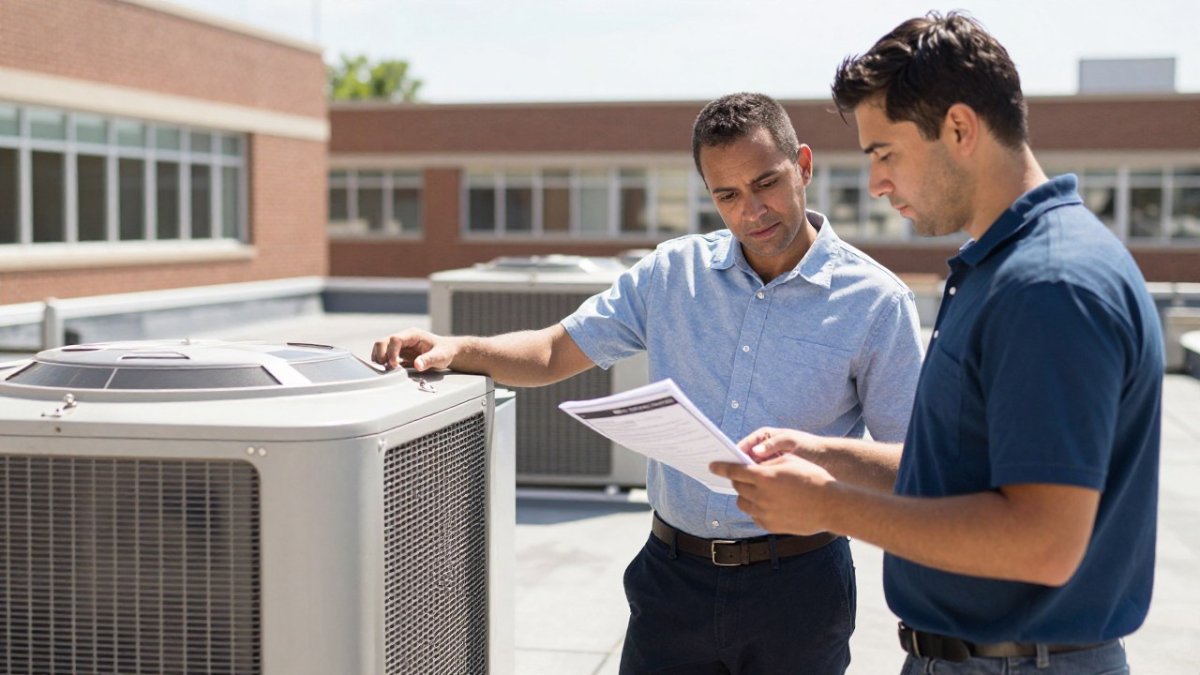
Walk through the plan once a year with custodial staff, the principal, and the business office. Practice what happens when the building loses heat on a school morning.
Information to Have Ready When You Call for Service
Dispatchers can respond faster when the first call includes the right details. Have these items ready:
- Building name and full address, including the entrance to use
- Equipment type and location, such as rooftop unit, boiler room, or classroom unit
- Equipment make and model, usually on the nameplate
Getting Same-Day HVAC Repair Without Waiting Weeks
Same-day repair depends largely on preparation. Districts that get a crew on site quickly are typically those whose buildings, equipment, and access details are already documented with their contractor.
What actually drives response time
Three factors determine whether a call becomes a same-day visit or a multi-day wait:
- Whether the contractor already services your equipment. Dispatchers prioritize known customers with service history, because a technician who has seen the boiler or rooftop unit before diagnoses faster.
- Whether the call includes usable information. A ticket that says "no heat in Room 12" sends a technician guessing. A ticket with the unit tag, make and model, alarm codes, and affected zones lets the dispatcher route the right technician with the right parts.
- Whether the building can be accessed outside school hours. Many repairs are faster after dismissal, when crews can shut down equipment, access ceilings, and make noise without disrupting instruction.
School-specific systems to name when you call
School buildings are not houses, and the equipment list matters. When you describe the failure, identify which of these is involved:
- Rooftop units (RTUs) serving classrooms, gyms, and cafeterias
- Boilers and hydronic loops serving perimeter heat, unit ventilators, and domestic hot water
- Chillers and chilled-water loops serving central air handling units
Naming the system type helps the dispatcher send a technician with the right certifications and truck stock. A boiler call and a rooftop-unit call are different trades.
What to have ready before you dial
Have these items in hand so the first call is the only call:
- Building name and full address, including the entrance the crew should use and any gate or key-card instructions
- Equipment type, tag number, and location, rooftop unit, boiler room, mechanical mezzanine, or classroom unit ventilator
- Equipment make and model, usually on the nameplate
Setting expectations on response windows
Ask any contractor you are evaluating what their emergency dispatch looks like: whether a live person answers after hours, what their typical response window is for your building type, and whether they can work outside normal school hours.
Watch out: a low after-hours rate can hide a slow response.
International Construction Solutions Ltd provides facilities maintenance services for ongoing coverage. Contact the team through the company website to discuss emergency response for your buildings.
Setting Up an HVAC Service Agreement for Your Schools
A service agreement turns emergency HVAC repair for schools from a reactive scramble into a planned program. A typical agreement covers scheduled preventive maintenance, priority emergency response, equipment documentation, and reporting.
When comparing agreements, look for clear response-time commitments, a named account contact, and documentation of past service.
For more on how these agreements are structured, see our guide to a commercial building maintenance service agreement.
Frequently Asked Questions
What would be considered an HVAC emergency at a school?
An HVAC emergency at a school is any failure that puts occupants at risk or makes classrooms unusable during school hours. Examples include no heat during freezing weather, no cooling in rooms where temperatures climb above safe levels for students, a gas odor near a furnace or boiler, carbon monoxide alarm activation, smoke or burning smells from equipment, and water leaking into electrical components. Staff should evacuate the affected area if there is any gas smell or CO alarm, then call the utility and emergency services before calling the HVAC contractor.
How quickly can emergency HVAC repairs be completed at a school?
Response time depends on the failure, parts availability, and the contractor's dispatch capacity. Many commercial contractors offer same-day response for critical failures, and some provide after-hours or early-morning dispatch for districts that open before standard business hours. Simple faults such as a tripped breaker or a failed control board are often resolved in one visit, while a failed compressor or rooftop unit may require ordering parts and a second visit. Ask any provider to state its target response window and repair time in writing.
What information should a school provide when requesting emergency HVAC service?
Have the building address, the name and direct phone number of an on-site contact, the affected equipment type and location, the symptoms observed, when the problem started, and whether occupants are present. Note any alarms, error codes shown on the control panel, recent maintenance or repairs, and any safety concerns such as gas odors or water leaks. Clear information lets the dispatcher prioritize the call and bring the right parts and technician to the first visit.
How can schools prevent HVAC emergencies?
Preventive maintenance is the most effective measure. Schedule filter changes, belt inspections, coil cleaning, and control checks before peak heating and cooling seasons. Keep an equipment log, track recurring faults, and replace aging units before they fail during the school year. A written service agreement with defined response times helps ensure preventive visits actually happen.
